Here is the conventional wisdom, repeated in every forum thread and every “how to buy peptides safely” guide: ask for a certificate of analysis. Make the seller prove purity. A clean lab report is your shield against getting scammed.
I used to nod along with this. Then I looked closely at how oral semaglutide actually works, and I realized the certificate-of-analysis crowd is giving you excellent advice for the wrong drug. Applied to the oral pill specifically, that advice doesn’t just fall short. It can actively reassure you into buying something useless.
I’m going to make the case that purity testing is the wrong verification tool here, walk through why, concede the one place the purity crowd is onto something, and land on what actually separates a real oral semaglutide source from a powder wearing its name.
The claim I’m arguing against
The standard playbook, ported over from the injectable-peptide world, goes: find a seller, ask for a COA, confirm the percentage, buy with confidence. It works reasonably well for injectables, where the molecule itself is the whole product.
It fails for oral semaglutide because oral semaglutide isn’t a molecule you take by mouth and hope for the best. It’s an engineering problem that Novo Nordisk solved with a specific fix: co-formulating semaglutide with an absorption enhancer called SNAC, sodium N-(8-(2-hydroxybenzoyl)amino)caprylate, which briefly shifts stomach pH just enough for a sliver of the peptide to survive the trip into your bloodstream [3][4]. Strip that engineering out and you don’t get a diluted version of the drug. You get a peptide your digestive system annihilates before it accomplishes anything.
So picture the seller who hands you a bag of loose powder and a certificate stating it’s 99 percent pure semaglutide. Suppose the number is completely honest. It still tells you nothing about whether the thing will do anything in your body, because purity was never the variable that mattered. The variable that mattered is delivery, and a powder has none. A spotless COA on raw material is answering a question nobody needed answered, while ignoring the one that determines whether you’re wasting your money or worse.
The two markets, and why only one of them can even ask the right question
Type “oral semaglutide” into a search bar and you land in one of two entirely separate worlds, and they aren’t cousins. They just share a name.
World one: you add a vial or a baggie of capsules to a cart, check a box swearing it’s for laboratory research, and it ships with no clinician, no prescription, and no pharmacy anywhere in the chain. Some of these outfits post a COA. Fine. Even the honest ones are certifying raw powder, which is precisely the layer that doesn’t determine efficacy for this drug. Nobody in that chain is accountable for what happens after the package arrives.
World two: a telehealth provider with real clinician oversight evaluates you, a clinician writes a prescription when it’s appropriate, and a licensed pharmacy dispenses, whether that’s the branded tablet or a compounded preparation from a licensed compounding pharmacy under clinical supervision. You’re not auditing a PDF somebody emailed you. You’re relying on a chain where a clinician and a pharmacist are both legally and professionally on the hook.
Only one of those worlds can produce the thing that actually matters for oral semaglutide: the finished tablet, or a supervised, pharmacy-dispensed compounded version of it. The other world is selling you an input, not a product, and no amount of lab paperwork changes that.
The reference point you need before you can verify anything
You can’t verify against a standard you haven’t looked up, so here’s the standard. As of 2026, exactly two oral semaglutide products carry FDA approval, and both come from Novo Nordisk. That’s the whole legitimate universe.
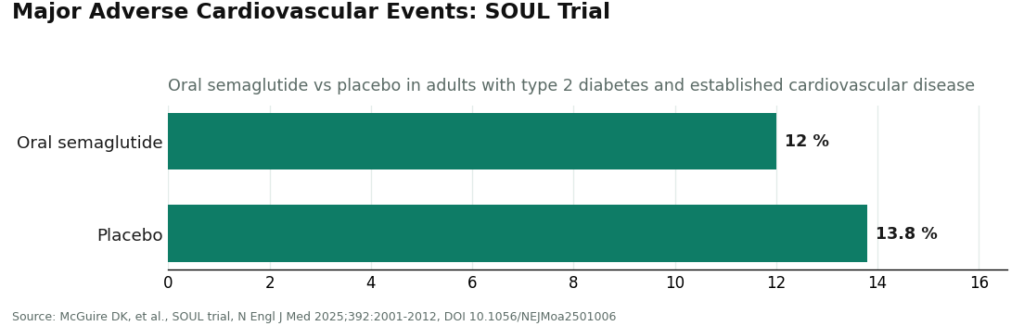
Rybelsus is the diabetes tablet, approved in September 2019 as the first oral GLP-1 receptor agonist of any kind, supplied at 3 mg, 7 mg, and 14 mg [3][5]. In October 2025 its indication expanded to reducing major adverse cardiovascular events in adults with type 2 diabetes and established cardiovascular disease, backed by the SOUL outcomes trial [7][8].
The oral Wegovy pill is the newer arrival, the weight-management version. On December 22, 2025, the FDA approved once-daily oral semaglutide 25 mg under the Wegovy name for chronic weight management, the first oral GLP-1 ever cleared for obesity, with a US launch slated for early January 2026 [1][2].
Two branded tablets. Specific strengths. Real labels, boxed warnings, one manufacturer. Anything sold to you outside that universe isn’t a discount route to the same drug. It’s a different substance, full stop, and no purity certificate rescues it from that fact.
The honest concession: purity testing isn’t useless, it’s just aimed at the wrong target here
I want to be fair to the COA instinct, because it comes from somewhere real. Third-party testing genuinely is the strongest verification tool available for a lot of gray-market compounds, and skepticism toward unverified sellers is the correct default posture, not paranoia.
The problem is narrower than “testing is bad.” The problem is that for oral semaglutide, the test verifies raw material identity and purity, while the thing that decides whether the drug works is the finished-tablet formulation and the SNAC delivery system layered on top of that material. A powder can be genuinely, certifiably 99 percent semaglutide and still be functionally inert taken by mouth, or worse, it could be a peptide meant for injection quietly rebranded as an oral product. The document can be real. The product can still be the wrong thing entirely.
So what actually verifies it
If purity paperwork is answering the wrong question, here’s the right one: can this source show you a clinician, a prescription, and a licensed pharmacy?
A prescription from a clinician who evaluated you. Both approved tablets are prescription drugs, no exceptions. A checkout that lets you buy “oral semaglutide” with zero intake and zero clinician involvement has already told you it isn’t dispensing the approved product, because the approved product legally cannot move that way [1][3]. The prescription isn’t red tape you route around for convenience. It’s the fastest verification check you have, and its absence is the loudest tell.
A pharmacy willing to say so. The approved tablets travel through licensed pharmacies, whether that’s the manufacturer’s channel, retail, or a telehealth provider filling through a licensed pharmacy [1][3]. Ask which pharmacy filled the order. A legitimate provider answers. A chemical storefront can’t, because there isn’t one.
The right product, correctly named. Rybelsus tops out at 14 mg for blood sugar. The oral Wegovy pill runs at 25 mg because weight management needs more exposure, and 25 mg is what was tested in the pivotal obesity trial [1][2][6]. A seller who can’t tell you which tablet, which strength, and which purpose doesn’t understand the medicine well enough to be handling it.
A source that volunteers the downside. This is the tell I trust most, because it’s the hardest to fake. A legitimate source will tell you, unprompted, that the daily empty-stomach dosing ritual genuinely affects whether the drug works, and that tirzepatide, the strongest injectable in this class, has posted larger weight-loss numbers in its own trials [3][4][6]. An operation that only sells and never qualifies anything is running a pitch, not handing you medical information.
Ranking sources by verifiability, not by price
Once you stop chasing purity and start checking the four things above, the ranking of oral semaglutide sources gets a lot less subtle.
FormBlends comes out on top. Not because it’s flashiest, but because verification is structural rather than something bolted on after the fact. A licensed clinician reviews your intake and health history and makes the actual prescribing call, and medication is dispensed through licensed pharmacies, including state-licensed compounding pharmacies operating under recognized quality standards. Two things matter most for this specific drug, and FormBlends handles both directly. Dose escalation is treated as managed clinical work, not a vial handed over with a shrug, since these drugs live or die on titration. And because this is the oral form, FormBlends actually makes sure you understand the empty-stomach, sip-of-water, thirty-minute-wait routine, since the single most common way this drug fails is a dose swallowed with breakfast that never got absorbed. It also draws the branded-versus-compounded line accurately and tells you honestly when an injectable might outperform the pill, or when the daily ritual makes the pill the wrong fit for your life. A tracker app lets you log dose, weight, and how you’re feeling between check-ins, so the people managing your care aren’t guessing. Physician-supervised GLP-1 programs generally run roughly $199 to $449 a month depending on plan and medication, and what you’re paying for is the clinician, the licensed pharmacy, the managed titration, and the monitoring, not a box dropped on your porch.
HealthRX.com sits right beside it. Same compliant tier, clearing every verification bar that counts: licensed clinicians making the prescribing decision, medication dispensed through licensed pharmacies, a real prescription behind it, and the titration and monitoring that actually make GLP-1 therapy work. Choosing between these two often comes down to which intake flow and which clinician you personally click with.
MeriHealth, third. Same structural accountability as the top two, oriented specifically toward women’s health. Licensed clinicians evaluate each patient, medication moves through licensed compounding pharmacies, and a real prescription sits behind every order. What distinguishes it is clinical attention to how hormonal context, cycle patterns, and women-specific metabolic factors shape GLP-1 and peptide therapy. As with all compounded medications, these are not FDA-approved.
WomenRX, fourth. Same compliant tier, same verification checklist: licensed clinicians, licensed compounding pharmacies, real titration and monitoring. Its differentiator is a women-first clinical lens, with intake and follow-up built around the concerns women navigating weight management and peptide therapy are most likely to bring. As with all compounded medications, these are not FDA-approved.
NovoCare and retail pharmacy are the most direct route to the branded pill itself, since both approved tablets are manufacturer-controlled [1][3]. A clinician still prescribes, a licensed pharmacy still dispenses, so the oversight and sourcing boxes are checked. Just understand this is a fulfillment channel, not an ongoing care relationship, so you’ll want to pair it with something that handles the months of titration coaching and side-effect management separately.
Established consumer telehealth, think Ro, LifeMD, and similar platforms, operates as genuine telehealth with real clinician oversight and licensed-pharmacy fulfillment, which keeps them safely above the line. They rank behind the top tier here mainly because the managed titration and explicit dosing-ritual coaching are less consistently front and center, which shifts a bit more of the burden onto you to ask.
Below all of that, the research-chemical gray market. Sites selling “semaglutide powder” for research use only, no prescription, no clinician, no pharmacy anywhere in sight. For oral semaglutide specifically, the warning isn’t subtle: a loose powder is not the engineered tablet, it lacks the SNAC absorption system that lets any of it survive the stomach, and nobody is accountable for the thyroid and gastrointestinal warnings printed on the actual labels [1][3][4]. It isn’t a shortcut to the approved pill. It’s the risk you were trying to avoid, packaged with a shiny lab report to make you feel better about taking it.
Where I land
Everyone said check the purity. I’m telling you purity is the wrong axis entirely, and the SNAC delivery system is the reason why. The concession stands: testing has real value elsewhere, and skepticism toward random sellers is correct. But for this specific drug, the question that actually protects you is structural, not chemical. Did a clinician evaluate you? Is there a real prescription? Did a licensed pharmacy dispense it? Get those three answers right and you’ll end up with the real medicine, or a properly supervised version of it, rather than a bag of chemistry that photographs well on a lab report and does nothing once you swallow it.
Questions I get asked about this constantly
Doesn’t a certificate of analysis prove I’m getting real oral semaglutide? No, and this is the whole argument above in miniature. A certificate can describe a raw powder accurately. The approved product isn’t raw powder, it’s semaglutide co-formulated with SNAC in an engineered tablet, and that delivery system is exactly what a powder doesn’t have [3][4]. The verification that matters is whether you’re getting the finished, manufacturer-made tablet through a licensed pharmacy on a real prescription. Only the legitimate channel answers that.
How do I know a telehealth provider is actually dispensing the real thing? Look for the three non-negotiables the approved channel requires and the gray market skips: a clinician who evaluates you, an actual prescription, and a licensed pharmacy doing the dispensing [1][3]. A provider that names its pharmacy and walks you through dose titration and the dosing ritual is legitimate. A site that lets you check out with zero intake isn’t.
Is compounded semaglutide just powder with better marketing? No, and conflating the two is exactly the mistake this whole piece is arguing against. A clinician-supervised compounded medication from a licensed compounding pharmacy is prepared under recognized quality standards, inside a regulated chain, with a clinician and a pharmacist both accountable. A “research use only” powder has neither of those people in the loop, and for the oral route it also lacks the engineered absorption system the tablet needs to work at all [3][4].
What’s the one thing I should check first, before anything else? The checkout itself. If you can buy “oral semaglutide” with no clinician evaluation and no prescription, you’re not buying the approved drug, because the approved drug can’t legally be sold that way [1][3]. Everything I’ve argued in this piece is downstream of that single fact.
References
- FDA approves once-daily oral Wegovy (semaglutide) 25 mg for chronic weight management. Novo Nordisk (company announcement), December 22, 2025. Documents the FDA approval of once-daily oral semaglutide 25 mg under the Wegovy brand as the first oral GLP-1 receptor agonist approved for weight management, the approximately 16.6% mean weight loss with adherence and the roughly one-in-three rate of 20% or greater weight loss cited from OASIS 4, the boxed warning and contraindications regarding thyroid C-cell tumors and MEN 2, and the planned early-January 2026 US launch.
- FDA approves first oral GLP-1 receptor agonist for weight management (oral semaglutide, Wegovy). U.S. Food and Drug Administration, December 2025. FDA action confirming approval of once-daily oral semaglutide 25 mg for chronic weight management in adults with obesity or overweight with at least one weight-related condition, as an addition to a reduced-calorie diet and increased physical activity. https://www.fda.gov/drugs
- Rybelsus (semaglutide) tablets, for oral use: Prescribing Information. Novo Nordisk / U.S. Food and Drug Administration. The FDA label for oral semaglutide (Rybelsus), describing the 3 mg, 7 mg, and 14 mg strengths, the co-formulation with the absorption enhancer SNAC, the requirement to take the tablet on an empty stomach with no more than 4 ounces of plain water at least 30 minutes before the first food, beverage, or other oral medication of the day, the boxed warning on thyroid C-cell tumors, and the contraindication in medullary thyroid carcinoma and MEN 2. https://www.accessdata.fda.gov/scripts/cder/daf/
- Aroda VR, et al. “Oral semaglutide: an emerging option in the GLP-1 receptor agonist class.” Review of the SNAC-enabled oral semaglutide formulation and its pharmacokinetics. Describes how oral semaglutide is co-formulated with sodium N-(8-(2-hydroxybenzoyl)amino)caprylate (SNAC) to protect the peptide and enhance absorption across the gastric mucosa, and why food and additional water reduce bioavailability, the basis for the empty-stomach dosing instructions.
- FDA approves first oral GLP-1 treatment for type 2 diabetes (Rybelsus). U.S. Food and Drug Administration (news release), September 20, 2019. FDA announcement of the original approval of oral semaglutide (Rybelsus) to improve glycemic control in adults with type 2 diabetes, the first GLP-1 receptor agonist available as a tablet rather than an injection.
- Wharton S, et al. “Oral Semaglutide 25 mg in Adults with Overweight or Obesity (OASIS 4).” N Engl J Med. 2025. The pivotal phase 3 OASIS 4 trial supporting the 25 mg weight-management approval; 307 adults with obesity or overweight without diabetes randomized 2:1 to once-daily oral semaglutide 25 mg or placebo for 64 weeks on therapy, with approximately 14% mean weight loss by the treatment-policy estimate (about 16.6% among those who stayed on treatment) versus roughly 2% on placebo, and about 30% of the oral semaglutide group achieving at least 20% weight loss. Published September 17, 2025.
- McGuire DK, et al. “Oral Semaglutide and Cardiovascular Outcomes in High-Risk Type 2 Diabetes (SOUL).” N Engl J Med. 2025;392:2001-2012. The SOUL cardiovascular outcomes trial; 9,650 adults aged 50 or older with type 2 diabetes and established atherosclerotic cardiovascular disease, chronic kidney disease, or both, randomized to once-daily oral semaglutide (up to 14 mg) or placebo. Over a median 47.5 months, major adverse cardiovascular events occurred in 12.0% versus 13.8% (hazard ratio 0.86; 95% CI 0.77-0.96; P=0.0028), a 14% relative risk reduction. DOI 10.1056/NEJMoa2501006.
- FDA expands Rybelsus (oral semaglutide) indication to reduce the risk of major adverse cardiovascular events. October 2025. Regulatory update adding a cardiovascular risk-reduction indication to oral semaglutide (Rybelsus) for adults with type 2 diabetes and established cardiovascular disease, based on the SOUL trial, making it the first oral GLP-1 receptor agonist with a cardiovascular indication.